What’s this about?
This site is an official rules reference for Origin Story by Stonemaier Games.
It’s great for finding a specific rule quickly. It’s also an excellent supplement to the rulebook included in the box, when watching a how-to-play video, or while teaching the game.
Usage Tips
Back & Forward Nav: Think of each rule entry as a separate webpage. If you want to jump back, hit your Back button.
Check the Index : Don’t see what you’re looking for? The Index has every term in the game.
Install it: This site is a (Progressive Web App). You can install it as a standalone app that is lightning fast, and works even when you’re offline.
Link to a rule: Want to share a link to a particular rule? Just click its title!
Credits
- Last checked
Abilities
Abilities are special powers found on story cards, your character mat, superhero cards, and event cards that can be activated during gameplay. Story card and character mat abilities must be charged with stamina tokens before they can be used. Abilities on event and superhero cards do not require charging.
Sources of Abilities
Story Cards: Each story card you play onto your player mat (in rounds 1-4) contains one or more abilities. These cards show their stamina cost in the upper left corner.
Character Mat: Your player mat shows a character-specific ability and stamina cost. This ability can be charged and used like story card abilities.
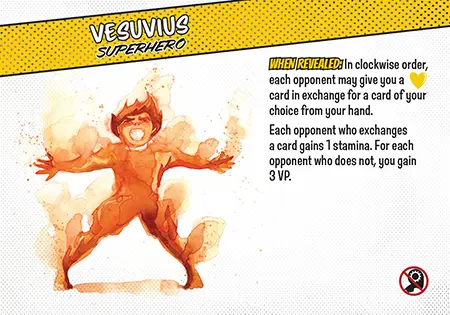
Superhero Cards: In round 5, when you reveal your chosen superhero card, it provides abilities. "When Revealed" abilities trigger immediately and do not require charging. Other abilities (such as "Ongoing" or "End of Round") are active once the card is revealed.
Solo Mode Effects
When playing against the Vancardians, some ability effects work differently.
Exchange a card: When an ability has you exchange a playing card with a Vancardian:
- Take her lowest non-love () card. If she has only love () cards, take the lowest of those.
- Choose 1 of your cards (not the one the Vancardian gave you) and place it as the leftmost card in her hand.
Reveal: If you reveal playing cards (temporarily or permanently):
Charging Abilities
During the "Charge Abilities" phase of round setup, place your stamina tokens on your abilities to charge them.
Important Rules
Abilities that mention "cards" are referring to playing cards (not story, event, or superhero cards).
Printed card values range from 1 to 13, but abilities may change them to below 1 or above 13.
If an ability changes the suit or value of a card and this results in a tie, the first-played card wins the tie.
If two abilities trigger at the same time or seem to contradict each other, resolve them in clockwise order starting with the player to the left of the dealer. Pay close attention to the timing words on abilities (e.g., "whenever you lead," "when you win a trick"), as these usually prevent timing issues.
Any increase in stamina is permanent. Removed and returned stamina go to your personal stamina supply (unless an ability specifies that you permanently lose stamina).
Ability Types
Story card and character mat abilities have no effect unless charged. Abilities on event and superhero cards do not require charging and apply when those cards are revealed.
End of Round
These abilities apply during the end of round stage (after all tricks).
End of Trick
These abilities apply at the end of each trick.
First/Final Trick
These abilities only apply during the first or final trick of a round.
On Your Turn
These abilities apply during each of your turns.
Ongoing
These abilities apply continuously throughout the round.
Remove
These abilities have the phrase “You may remove X stamina” (X is typically 1 or 2). If you charged such an ability during round setup, you may remove stamina from the ability’s card (it goes to your supply) to activate the ability.
When Charged
These abilities apply the moment you place stamina on story cards during round setup.
Whenever You Lead
These abilities apply whenever you are the leader of a new trick.
Win/Lose a Trick
These abilities apply every time you win or lose a trick.
Solo Mode
When playing against the Vancardians, some abilities work differently.
Exchange a card: Take the Vancardian’s lowest non- card if possible, otherwise lowest . You choose 1 of your cards to place as her leftmost.
Alignment
At the beginning of each round, during round setup, you choose your alignment for that round. Your alignment determines your goal for the round and how you score victory points at the end of the round.
Choosing Your Alignment
During the "Reveal Alignment" phase of round setup, simultaneously with the other players, place your alignment dial in front of you, revealing your choice of either the hero or villain side.
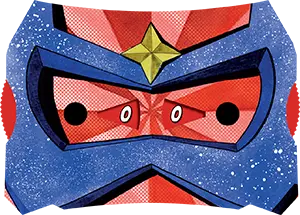
Hero
As a hero, you will try to win as many tricks as possible. At the end of the round, you gain 1 VP per trick won.
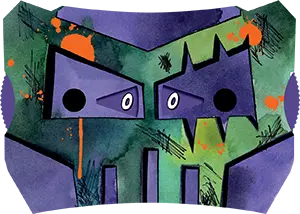
Villain
As a villain, you will try to lose every trick. At the end of the round, if you won zero tricks, you gain 4 VP.
Important Rules
For both hero and villain, the number of tricks is counted only at the end of the round. For example, if you won a trick as a villain but used an ability to give that trick to another player during the round, it does not count as a trick won.
There are a few story cards that can change your alignment during the round. For all hero/villain scoring, it's only your end-of-round alignment and tricks won that matter.
Even when event cards present special scoring rules, players still also score for their hero/villain alignment as usual.
Components
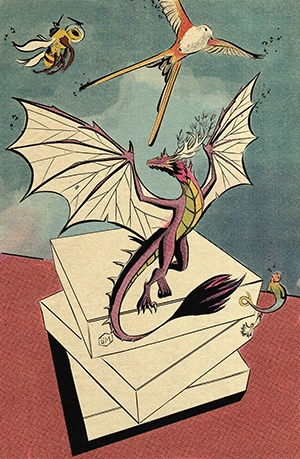 5 player mats
 8 Vancardian Cards
 8 Vancardian Cards
 64 story cards
Dealer
The dealer is the player who holds the dealer token. The dealer has specific responsibilities during round setup and determines turn order for certain actions.
Determining the First Dealer
During setup, the player who most recently watched a superhero movie gains the dealer token (or assign it randomly).
Dealer Responsibilities
During the "Deal Cards" phase of round setup, the dealer:
Gathers all 52 playing cards
Shuffles them into a deck
Deals 8 cards face down to each player
In two-player games, the dealer also deals each sidekick a hand of 8 face-down cards. After dealing, flip 2 cards of each sidekick's hand face up.
Dealer and Turn Order
The dealer determines turn order for several actions:
First Trick Leader: The player to the left of the dealer leads the first trick of each round.
Charging Abilities: Costs with depend on or affect other players. Charge these before other abilities in clockwise order starting with the player to the left of the dealer.
Choosing Superhero Cards: In round 5, players choose their superhero cards in clockwise order starting with the player to the left of the dealer.
Dealer Rotation
At the end of each round, the dealer token rotates clockwise to the next player.
Two-Player Games
Sidekicks are never the dealer, and they never lead (if it would be their turn to lead, their player leads instead).
End of Game
The game ends after the 5th round. The winner is the player with the most victory points. If multiple players are tied for the most victory points, they share the victory.
Victory Points
Victory points (VP) are tracked using the alignment/VP dial. Each player starts with 0 VP at the beginning of the game.
Whenever you gain or lose VP, update your VP dial immediately (not just at the end of the round).
Players gain victory points from several sources:
Alignment: At the end of each round, heroes gain 1 VP per trick won. Villains gain 4 VP if they won zero tricks.
Story Card Abilities: Many story card abilities can grant victory points when triggered.
Superhero Card Abilities: Superhero cards often grant victory points when revealed or through their abilities.
Event Card Abilities: Event cards in round 3 may grant victory points through their special rules.
Events
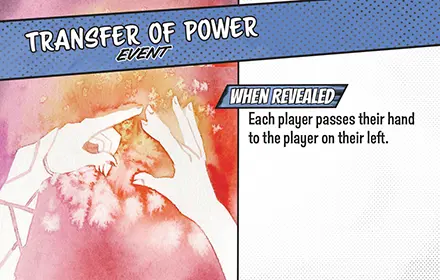
Event cards add special rules and twists to round 3.
When Events Happen
Events only appear in round 3. During round setup, the dealer reveals 1 random event for all players to follow.
Event Abilities
Event cards can have different types of abilities that apply at various times:
- When Revealed abilities apply immediately when the event card is revealed during round setup.
- Ongoing abilities apply continuously throughout the round.
- End of Trick abilities apply at the end of each trick.
- Final Trick abilities only apply during the final trick of the round.
- End of Round abilities apply during the end of round stage (after all tricks).
Scoring
Even when events present special scoring rules, players still also score for their hero/villain alignment as usual.
End of Round 3
At the end of the third round, resolve any "End of Round" abilities on the event card, then discard the event card face down.
Extra-Love Cards
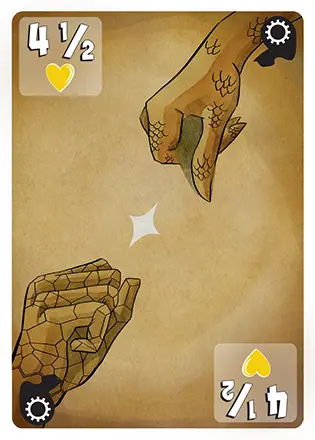
Extra-love cards are solo-only love () cards used by the Vancardians. They are not part of the standard 52-card deck.
Setup
During solo setup, set the 4 extra-love cards off to the side—they are not dealt to you or the Vancardians.
Adding Extra-Love Cards
Extra-love cards enter play only when a Vancardian card’s Effects say Add X (such as 4½ or 9½):
Discard the rightmost card in each Vancardian’s hand.
Place an extra-love card with value X as the leftmost card in that Vancardian’s hand.
Using Extra-Love Cards
Once added, extra-love cards behave like normal love () cards with fractional values:
They are love () suit cards for following suit and trump.
Their fractional values (like 4½ and 9½) count for all highest/lowest and trick-winning checks—e.g., 9½ beats 9.
The Vancardians play them using the usual solo rules for leading and following.
Face-down Cards
Cards that are discarded or won in tricks are placed face down and cannot be looked at.
What You Can Look At
- Your own hand of cards
- Your own superhero cards at any time
Cards Won in Tricks
When a player wins a trick, they place the cards face down in a pile in front of them. These cards remain face down for the rest of the round and cannot be looked at. In two-player games, if a sidekick wins a trick, discard those cards instead.
Discarding
Always discard face down. You will discard…
- Unchosen story cards in rounds 1–4.
- The unchosen superhero card in round 5.
- The event card after resolving it in round 3.
- Playing cards when abilities cause discarding.
- Playing cards won by sidekicks in tricks in two-player games.
Discard Pile
If a card deck is empty and a card needs to be drawn, shuffle the discard pile to form a new deck. If the deck is empty and there is no discard pile, skip the draw.
How to Play
Origin Story is played over 5 rounds — each divided into three phases:
Deal Cards: The dealer gathers all 52 playing cards, shuffles them into a deck, and deals 8 cards face down to each player. You may only look at your own hand of cards.
Event: For round 3 only, The dealer reveals 1 random event for all players to follow. Even when these events present special scoring rules, players still also score for their hero/villain alignment as usual.
Story/Superhero Cards
Rounds 1–4: Each player gains one stamina from the general supply and draws 3 story cards. Play 1 story card face up onto your player mat over the number for the current round and discard the other 2 story cards.
Round 5: In clockwise order starting with the player to the left of the dealer, each player chooses one of their two superhero cards (which up until this time have served as reference cards), reveals it face up on the superhero space of their player mat, and gains its benefit. Discard the unchosen superhero cards.
Charge Abilities: Simultaneously with the other players, place your stamina tokens on your abilities to charge them.
Each story card shows its stamina cost in the upper left corner. Most cards have a single cost (e.g., represents 2 stamina). If an ability has two costs, you may choose how many of them to charge. Costs with are tied to “Remove” abilities (see Ability Types).
Your character mat shows a character-specific ability and stamina cost. This ability can be charged and used like story card abilities.
Costs with depend on or affect other players. Charge these before other abilities in clockwise order starting with the player to the left of the dealer.
Charged abilities are open information.
If you have excess stamina, it remains in your stamina supply for use in future rounds and may not be placed after this phase of the current round.
Reveal Alignment: Simultaneously with the other players, place your alignment dial in front of you, revealing your choice of either the hero or villain side.
Your setup and the event:
Gather and shuffle all 52 playing cards (exclude the extra-love () cards) into a deck. Deal 8 cards to yourself, placing them face up in a row above your player mat in any order.
At the beginning of round 3 only: Look at the or on the top card of the Vancardian deck. Draw the topmost card of the matching event deck and place it face up on top of the event deck. Resolve that card’s round 3 event (left side) which applies only during this round.
At the beginning of rounds 1–4:
Gain 1 stamina token from the general supply.
Draw 3 story cards. Play 1 of them face up on your player mat over the number for the current round and discard the other 2.
At the beginning of round 5: Choose 1 of your 2 superhero cards, play it face up on the superhero space on your player mat, gain its benefits, and discard the other.
Charge abilities: Place your stamina tokens on your abilities to charge them:
Each story card shows its stamina cost in the upper-left corner. Most cards have a single cost, e.g., is a single 2-stamina cost. If an ability has two costs, you may choose how many to pay to vary its utility. Costs with are tied to “Remove” abilities (see Ability Types).
“When Charged” abilities that cause cards to be exchanged with a Vancardian must be performed after “Vancardians’ setup” (below).
Your character mat shows a character-specific ability and stamina cost. This ability can be charged and used like story card abilities.
If you have excess stamina, it remains in your stamina supply for the rest of the round and may not be placed later during that round.
Choose alignment: Place your alignment/VP dial with your chosen side up: red hero (your goal is to win tricks) or purple villain (your goal is not to win any tricks).
Vancardians’ setup:
Set the 4 extra-love () cards off to the side.
For each Vancardian, deal 8 playing cards and place them face up in a row from left to right in the order they were drawn.
-
Draw the topmost card from the Vancardian deck and resolve the effects (right side) (if any) written next to the round number of the current round:
Replace X: Draw X playing cards and place them as the rightmost cards of each Vancardian’s hand from left to right in the order drawn.
If you play hero, discard from each Vancardian’s hand X non-love () cards in value order from lowest to highest. Change to love () if they run out of non-love () cards.
If you play villain, replace Vancardian’s X highest cards including love ().
Add X: Discard the rightmost card in each Vancardian’s hand, then place an extra-love () card with the value X on it as the leftmost card.
Move X left: Move the rightmost love () card (if any) in each Vancardian’s hand to be the leftmost card. Do this X times. If no card was moved for a Vancardian do Replace X instead for her.
-
Resolve any “When Charged” abilities that you delayed during step 1.e.ii because they cause cards to be exchanged with a Vancardian.
Reminder: The Vancardians always choose the hero alignment.
Play a series of 8 tricks. The leader for the first trick of each round is the player to the left of the dealer.
Each trick has 4 steps: The leader plays a card, the other players follow (playing on suit if possible), the winner is determined, and players transition to the next trick. While these are the standard rules for trick-taking in Origin Story, many story cards will allow you to break these rules.
Two-Player Games
Play tricks using the above rules, alternating between players and sidekicks. When it is your sidekick’s turn to play a card, select from their 2 face-up cards (follow suit if possible), then flip another card face up if possible. If a sidekick wins a trick, discard those cards (the trick does not belong to their player). Sidekicks are never the dealer, and they never lead (if it would be their turn to lead, their player leads instead). They do not score victory points, nor can players interact with them using story cards. Abilities do not affect them (e.g., only players pass cards for the Transfer of Power event, ignoring sidekicks).
Your Turns
You take your turns as normal. However, when playing against the Vancardians, some abilities work differently.
Exchange a card: When an ability has you exchange a playing card with a Vancardian:
- Take her lowest non-love () card. If she has only love () cards, take the lowest of those.
- Choose 1 of your cards (not the one the Vancardian gave you) and place it as the leftmost card in her hand.
Reveal: If you reveal playing cards (temporarily or permanently):
If you play hero, subtract 1 from each revealed card’s value.
-
If you play villain, add 1 to each revealed card’s value.
Designers’ tip: Consider marking revealed cards with a stamina token as a reminder.
Surrender
At the beginning of any of your turns where a Vancardian leads: You may SURRENDER to the leader unless you’re playing villain and have no tricks:
- The leading Vancardian gains 1 VP per card remaining in her hand plus 1 VP for the in-progress trick.
- The round immediately ends.
- Abilities that refer to the number of tricks in a hand or the content of tricks do not trigger.
- The round is otherwise scored normally.
Designers’ tip: In some cases, you can use surrendering to your advantage—thematically, you surrender to one Vancardian and assist her in stopping the other.
A Vancardian Turn
Vancardians take their place in the turn order, which goes top to bottom through the hands on the table, wrapping around from the bottom to the top.
Reminder: If the deck of playing cards runs out, shuffle the discard pile to make a new deck.
When using the procedures below to determine what card a Vancardian will play, only consider cards that she can legally play. For example, when you play the story card Trance, she is limited by its rules when she follows.
Vancardian Turn Examples
When a Vancardian Leads
- If you play villain and have no tricks, the Vancardian plays her lowest card.
- Otherwise, she plays her highest card.
When a Vancardian Follows
- Draw 2 playing cards:
- For each of the drawn cards, discard it if its suit isn’t already in the Vancardian’s hand.
- Discard, from the right end of her hand as many cards as you kept in step a (if any). In the last trick of a round, you’ll almost always only be able to discard 1 card even if you keep 2.
- Place the kept cards (if any) in the order drawn in the Vancardian’s hand, starting to the right of the row.
- If you play villain and have no tricks:
- She plays the lowest, non-love () card she can legally play.
- If love () is the only legal option, she plays her lowest love () card.
- Otherwise, if she has cards of the lead suit:
- If she has at least 1 lead suit card that beats all cards played so far in this trick, she plays the lowest of those.
- If she doesn’t, she plays her lowest lead suit card.
- Otherwise, she plays her lowest card of any suit.
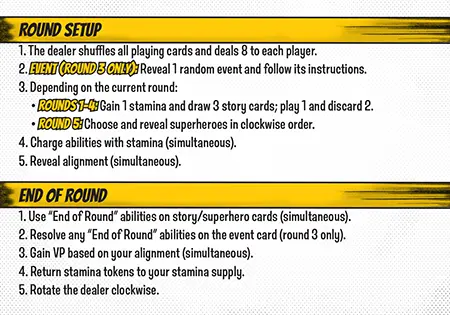
A round ends after 8 tricks. Then each player follows these steps:
You may use “End of Round” abilities on your charged story cards (and, in round 5, your superhero card).
At the end of the third round, resolve any “End of Round” abilities on the event.
Gain VP based on your alignment as a hero or villain this round.
Return all stamina from your abilities to your stamina supply.
The dealer token rotates down to the next player.
Icons
Example: Lead and Follow
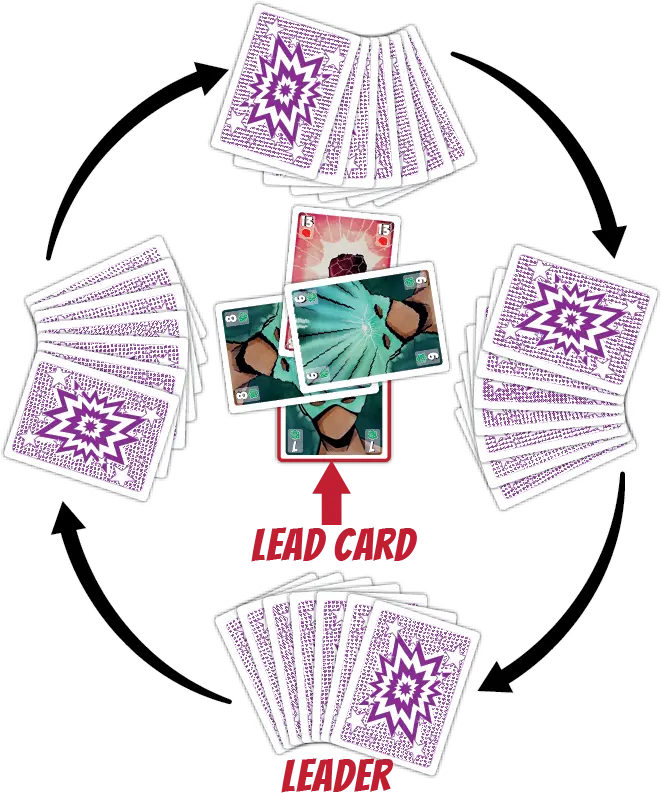
The Leader played 7 brains for the lead card. Going clockwise, each player played a brains card except for player 2, who had no brains cards to play.
Origin Story
Designed by Jamey Stegmaier and Pete Wissinger. Art by Clémentine Campardou.
- 1–5 players
- 45 minutes
- ages 14+
- competitive
Your inner superhero is ready to emerge, one chapter at a time. Reveal your backstory, gather gadgets and allies, develop a grudge against your archenemy, and unleash an ultimate ability as you transform. Use a combination of brains, love, speed, and strength to craft your origin story.
Origin Story is an engine-building, trick-taking game played over 5 rounds. Each round represents a chapter in your development and grants a new card to add to your player mat. Charge your cards and use their abilities to help you score more points than your opponents.
Gameplay
Origin Story is a must-follow trick-taking game with love () as the trump suit. The game is 5 rounds of 8 tricks each.
At the beginning of each round, players will use stamina to charge story cards on their player mat (often after playing a new story card). Then they choose their alignment for the round; heroes want to win tricks, and villains want to lose all tricks.
The 3rd round includes a twist in the form of a random event card, and the 5th round begins with each player revealing their superhero identity.
After playing all 5 rounds, each player will have a complete origin story comprising their character, 4 story cards, and 1 superhero card.
Player Mats
Each player mat showcases your character’s growth as you unlock new powers through story cards, culminating in your superhero card—the capstone of your origin story.
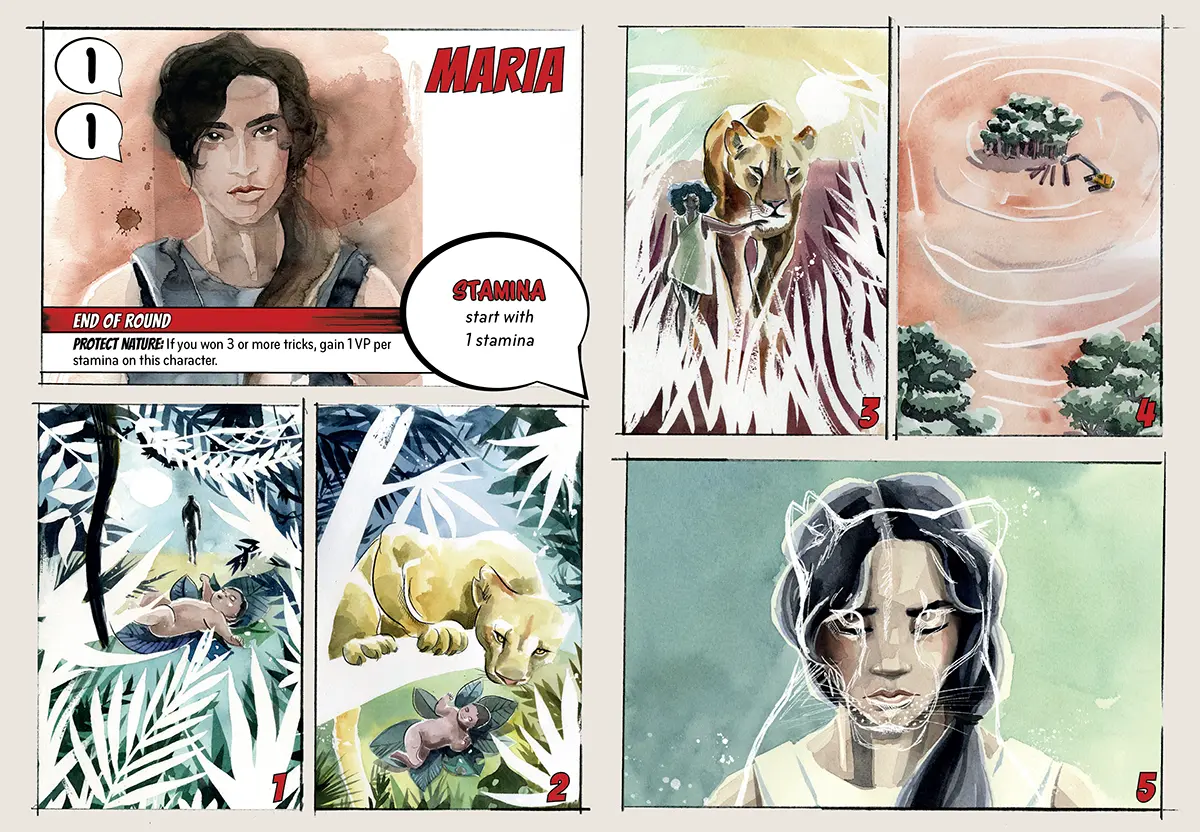
Each player mat contains several spaces:
- Character: Your player mat shows a character-specific ability and stamina cost. This ability can be charged and used like story card abilities.
- Story Card Spaces: Numbered spaces for rounds 1-4 where you place story cards face up.
- Superhero Space: Where you place your chosen superhero card in round 5.
- Stamina Supply: An area on your player mat where you keep your stamina tokens.
Placing Cards on Your Player Mat
In rounds 1-4, play 1 story card face up onto your player mat over the number for the current round. The other 2 story cards are discarded.
In round 5, reveal your chosen superhero card face up on the superhero space of your player mat. The unchosen superhero card is discarded.
After playing all 5 rounds, each player will have a complete origin story on their player mat comprising their character, 4 story cards, and 1 superhero card.
Stamina Supply
During setup, gain 1 stamina token and place it in the stamina supply on your player mat. Your stamina supply is where you keep all your stamina tokens throughout the game.
Playing Cards & Suits
The 52 playing cards are divided into four suits. Each suit contains 13 cards with values from 1 through 13.
Abilities that mention "cards" are referring to playing cards (not story, event, or superhero cards).
The Four Suits
There are four suits, each representing a different attribute:
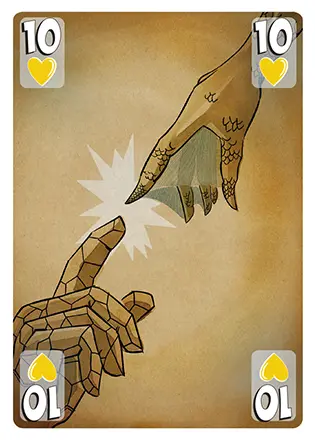 Love The trump suit
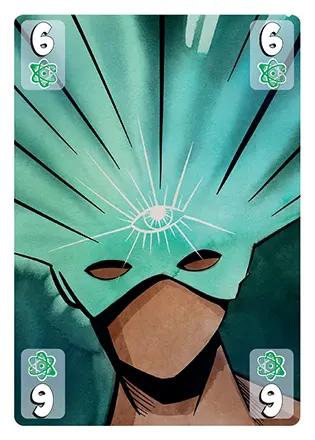 Brains
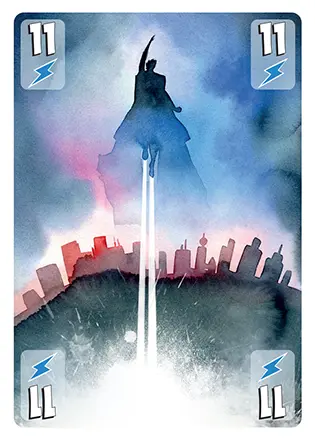 Speed
Speed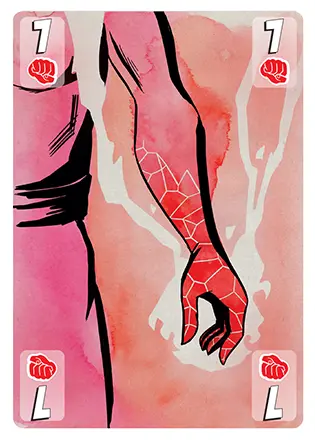 Strength
Card Values
Each suit contains cards numbered from 1 to 13. The printed values on cards range from 1 to 13, though abilities may modify card values to below 1 or above 13.
Following Suit
During trick-taking, players must follow suit when possible. This means:
If you have a card that matches the lead suit (the suit of the first card played in a trick), you must play it.
If you have no cards matching the lead suit, you may play off suit (a card of a different suit).
The Trump Suit
Love () is the trump suit. Love cards have special priority when determining the winner of a trick.
Normal winning: If no trump cards are played, the player who played the highest-valued card of the lead suit wins the trick.
Trump priority: If any love () cards are played in the trick, the player who played the highest-valued love card wins the trick, regardless of:
- Whether love was the lead suit
- The values of other cards in the trick
- Whether other players followed suit
This means that even a low-value love card (like 1) can beat a high-value card of another suit (like 13) if no other love cards are played in that trick.
Tie-Breaking
If an ability changes the suit or value of a card and this results in a tie, the first-played card wins the tie.
Rounds
Each game of Origin Story consists of 5 rounds.
Round Setup
- Deal Cards: The dealer deals 8 cards face down to each player and sidekick.
- Sidekicks: Flip 2 cards of each sidekick's hand face up.
- Event: The dealer reveals 1 random event for all players to follow.
- Stamina: Each player gains 1 stamina from the general supply.
- Story Cards: Each player draws 3 story cards, plays 1, and discards the other 2.
- Superhero Cards: Each player chooses one of their two superhero cards and reveals it face up on the superhero space of their player mat.
- Charge Abilities: Place stamina tokens on abilities starting with the player to the left of the dealer, then charge remaining abilities simultaneously.
- Alignment: Each player chooses their alignment for the round.
Trick-Taking
Play a series of 8 tricks, starting with the player to the left of the dealer.
End of Round
- Use “End of Round” abilities on your charged story cards and superhero card.
- Resolve any “End of Round” abilities on the event card, then discard the event.
- Gain VP based on your alignment as a hero or villain this round.
- Return all stamina from your abilities to your stamina supply.
- The dealer token rotates clockwise to the next player.
Round Setup
- Deal Cards: Shuffle the playing cards and deal 8 cards to yourself.
- Event: Draw a card from the event deck that corresponds to or on top of the Vancardian deck and resolve the event.
- Stamina: Gain 1 stamina from the general supply.
- Story Cards: Draws 3 story cards, play 1, and discard the other 2.
- Superhero Cards: Play 1 of your superhero cards and discard the other.
- Charge Abilities: Place stamina tokens on your abilities. (Delay “When Charged” abilities that exchange cards with Vancardians.)
- Alignment: Choose your alignment for the round.
- Vancardian Effects: Draw a Vancardian card and resolve the round 12345 effects.
- Exchange: Resolve “When Charged” abilities that exchange cards with Vancardians.
Trick-Taking
- When A Vancardian Leads
- When A Vancardian Follows
- Draw 2 playing cards:
- Keep those matching suits currently in her hand.
- Replace rightmost card(s) by kept cards.
- You play villain and have no tricks: The Vancardian plays lowest non- card (if possible) she can legally play.
- Otherwise, if she has a lead suit card:
- If she has a lead suit card that beats all cards played, she plays lowest of those.
- If not: Lowest lead suit.
- Otherwise: Lowest of any suit.
- Draw 2 playing cards:
- Your Turns
- Take your turn as normal OR
- Surrender (unless you’re playing villain and have no tricks): Leading Vancardian gains 1 VP per card remaining in her hand plus 1 VP for the trick in progress. The round ends immediately. Abilities that refer to tricks don’t trigger. The round is otherwise scored as normal.
End of Round
- Use “End of Round” abilities on your charged story cards and superhero card.
- Resolve any “End of Round” abilities on the event card, then discard the event.
- Gain VP based on your alignment as a hero or villain this round.
- Return all stamina from your abilities to your stamina supply.
- The dealer token moves down to the next player.
Setup


Place the stamina tokens within reach of all players to form a general supply.
Shuffle the story cards and place them face down in the general supply.
Shuffle the event cards and place them face down nearby.

Gain 1 random player mat.
Gain 1 alignment/VP (victory point) dial; place it near your player mat set at 0 VP.
Gain 1 stamina token and place it in the stamina supply on your player mat.
Gain 2 random superhero/reference cards. Look at them and place them face down on the superhero space of your player mat (you will choose 1 at the start of round 5). Return unused superhero cards to the box.
The player who most recently watched a superhero movie gains the dealer token (or assign it randomly).
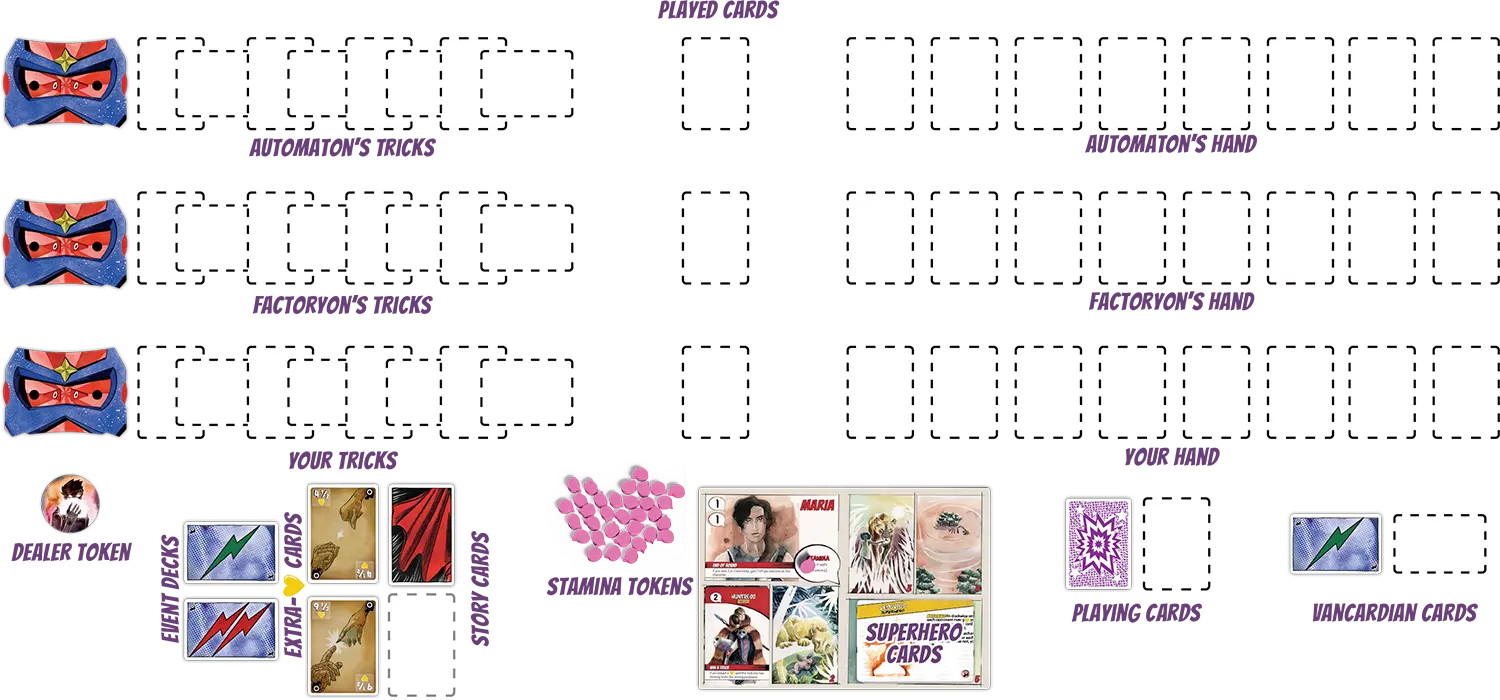
- Place the stamina tokens within reach to form the general supply.
- Shuffle the story cards and place them face down in the general supply.
- A random player gains the dealer token. Since the Vancardians are just stacks of cardboard, they can’t deal cards; you always do that, but the dealer token is used to determine who leads the first trick as normal.
- Gain 1 random player mat.
- Gain 1 alignment/VP (victory point) dial; set at 0 VP.
- Gain 1 stamina token and place it in the stamina supply on your player mat.
- Gain 2 random superhero cards. Look at them and place them face down on the superhero space of your player mat (you will choose 1 later in round 5). Return unused superhero cards to the box.
- Each Vancardian gains 1 alignment/VP dial, set at 0 VP with the red hero side up.
- Separately shuffle the 2 sets of Vancardian cards, and , to form a face-down event deck for each set.
- Select a difficulty level between 0 (easiest) and 5 (hardest), then—without looking—build the Vancardian Deck by drawing Vancardian cards equal to the chosen difficulty level and placing them face down, followed by enough Vancardian cards placed on top to bring the deck to 5 total cards (at level 5, add none). Do not shuffle the deck.
Sidekicks
In two-player games, each player has a sidekick positioned to their right. Sidekicks are not players, but they do play a card into each trick.
Round Setup
During the "Deal Cards" phase of round setup, deal each sidekick a hand of 8 face-down cards. After dealing, flip 2 cards of each sidekick's hand face up.
During Trick-Taking
Play tricks in clockwise order as normal, alternating between players and sidekicks. When it is your sidekick's turn to play a card, select from their 2 face-up cards, then flip another card face up if possible.
If a sidekick wins a trick, discard those cards. The trick does not belong to their player.
Restrictions
- Sidekicks are never the dealer.
- Sidekicks never lead. If it would be their turn to lead, their player leads instead.
- Sidekicks do not score victory points.
Interactions
- Players cannot interact with sidekicks using abilities.
- For example, only players pass cards for the Transfer of Power event, ignoring sidekicks.
Solo Mode
In a 1 player game, you play against 2 Vancardians (artificial opponents), Automaton and Factoryon, who each take the place of a human player.
- You play by the normal game rules, but the Vancardians are renegades who often do as they please.
- All core game rules not explicitly overridden by solo mode rules are still in effect. So, for example, love is the default trump suit.
- The Vancardians are considered players in the game.
- The Vancardians always choose the hero alignment.
- Many rules use criteria to select a playing card from a Vancardian’s hand. If there are multiple valid options, she chooses the leftmost one.
- When a rule refers to highest or lowest cards, it refers solely to the values of the cards (including any adjustments), so suits don’t matter. E.g., 5 is lower than 7.
- If you draw a story or superhero card with a , remove it from the game and draw a replacement.
- The hands of all 3 players will be placed in face-up rows; you’ll be able to see the Vancardians’ playing cards.
- No peeking: You may not look through the playing card discard pile or previous tricks.
Stamina
Stamina is a resource that players use to charge abilities. 36 stamina tokens form a general supply.
Starting Stamina
Each player starts with 1 stamina token, which is placed in the stamina supply on their player mat.
Gaining Stamina
During round setup in rounds 1-4, each player gains 1 stamina from the general supply (since you start with 1 stamina and gain another in round 1, you’ll have 2 stamina in round 1). Some abilities and event cards may also grant stamina.
Any increase in stamina is permanent. Removed and returned stamina go to your personal stamina supply (unless an ability specifies that you permanently lose stamina).
Charging Abilities
During the "Charge Abilities" phase of round setup, players simultaneously place their stamina tokens on their abilities to charge them:
Each story card shows its stamina cost in the upper left corner. Most cards have a single cost (e.g., represents 2 stamina). If an ability has two costs, you may choose how many of them to charge.
Your character mat shows a character-specific ability and stamina cost. This ability can be charged and used like story card abilities.
Costs with are tied to "Remove" abilities. You must charge these abilities during round setup if you want the option to use them later.
Costs with depend on or affect other players. Charge these before other abilities in clockwise order starting with the player to the left of the dealer.
Charged abilities are open information—all players can see which abilities you have charged.
If you have excess stamina, it remains in your stamina supply for use in future rounds and may not be placed after this phase of the current round.
Removing Stamina
Some abilities have the phrase "You may remove X stamina" (X is typically 1 or 2). These are called "Remove" abilities and work differently from standard abilities:
Standard abilities apply automatically when their trigger condition is met (as long as they're charged).
Remove abilities are optional—you choose whether to activate them. If you charged such an ability during round setup, you may remove stamina from the ability (it goes to your supply) to activate the ability when its trigger condition is met.
End of Round
At the end of each round, return all stamina from your abilities to your stamina supply so you can use it in the next round.
Story Cards
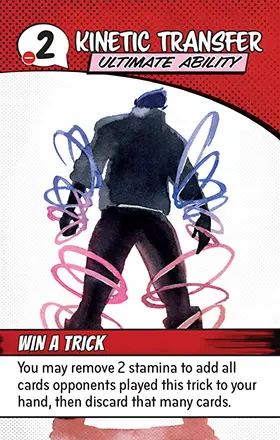
Story cards are the core component that builds your origin story. Each story card contains abilities that can be charged with stamina and used during gameplay.
The game includes 64 story cards. During setup, shuffle the story cards and place them face down in the general supply.
Acquiring Story Cards
In rounds 1-4, each player gains one stamina from the general supply and draws 3 story cards. Play 1 story card face up onto your player mat over the number for the current round and discard the other 2 story cards.
After playing all 5 rounds, each player will have a complete origin story comprising their character, 4 story cards, and 1 superhero card.
Discarding Story Cards
Always discard face down. In rounds 1-4, you discard the 2 story cards you did not choose to play. Story cards are discarded face down and cannot be looked at once discarded.
Superhero Cards
The superhero card is the capstone of your origin story. It represents your character's ultimate power and development.
During setup, each player gains 2 random superhero cards and places them face down on the superhero space of their player mat (you will choose 1 at the start of round 5). Return unused superhero cards to the box.
Superhero cards provide abilities that do not require charging. All superhero cards have “When Revealed” abilities that trigger immediately when you reveal your chosen superhero card in round 5. Some superhero cards also have “Ongoing” or “End of Round” abilities that are active once the card is revealed.
You may look at your superhero cards at any time, even before round 5.
Surrender
At the beginning of any of your turns where a Vancardian leads: You may SURRENDER to the leader unless you’re playing villain and have no tricks:
Trick-Taking
In a trick-taking card game like Origin Story, players play cards from their hands over a series of tricks. Follow these steps for each trick:
Leading
At the start of each trick, the leader selects any card of any suit from their hand and plays it face up on the table as the lead card. This card determines the trick’s lead suit: (brains), (love), (speed), or (strength).
Following
In clockwise order starting to the left of the leader, each other player plays a card face up on the table. Players must follow suit if possible: If they can play a card that matches the lead suit, they must do so. If none of their cards match, then they may play off suit (i.e., play a card of a different suit to the lead card).
Winning
Once every player has played a card, determine the winner of that trick. Normally, the player who played the highest-valued card of the lead suit wins the trick. However, is the trump suit, so its cards take priority. If the trick contains any love cards, the player who played the highest-valued love card wins the trick, even if love is not the lead suit
The winner of the trick places the cards from that trick face down in a pile in front of them, separate from other tricks they have won in that round. The winner then leads the next trick, and play continues until all 8 tricks have been played and the round ends.
Two-Player Games
Play tricks using the above rules, alternating between players and sidekicks. When it is your sidekick’s turn to play a card, select from their 2 face-up cards (follow suit if possible), then flip another card face up if possible. If a sidekick wins a trick, discard those cards (the trick does not belong to their player). Sidekicks are never the dealer, and they never lead (if it would be their turn to lead, their player leads instead). They do not score victory points, nor can players interact with them using story cards. Abilities do not affect them (e.g., only players pass cards for the Transfer of Power event, ignoring sidekicks).
Vancardian Cards
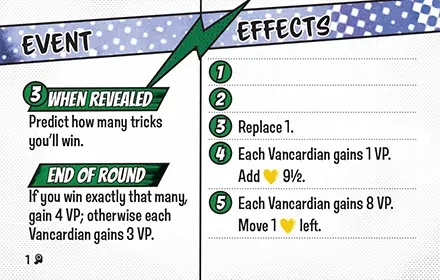
The solo mode uses 16 Vancardian cards: 8 cards and 8 cards.
Card Structure
Each Vancardian card has two sections:
- Event: A solo-only event that replaces the event cards used in multiplayer games. It creates a unique twist for the round, such as predicting how many tricks you will win, modifying card values, or changing how tricks are played.
- Effects: A row of effects for rounds 1–5 that adjust Vancardian VP or modify their hands using keywords like Replace X, Add X, and Move X left.
Using Vancardian Cards
During solo setup, you build a five-card Vancardian deck from these cards based on the chosen difficulty level, then shuffle the remaining cards into two event decks (one for and one for ).
At the beginning of round 3, the icon ( or ) on the top card of the Vancardian deck determines which event deck to draw from for that round’s Event. At the beginning of each round, you draw the top card of the Vancardian deck and resolve the card’s Effects listed next to that round’s number.
The effects on Vancardian cards always apply to both Vancardians unless a card says otherwise, and the Vancardians always use the hero alignment.
Vancardian Effects
Replace X: Draw X playing cards and place them as the rightmost cards of each Vancardian’s hand from left to right in the order drawn.
If you play hero, discard from each Vancardian’s hand X non-love () cards in value order from lowest to highest. Change to love () if they run out of non-love () cards.
If you play villain, replace Vancardian’s X highest cards including love ().
Add X: Discard the rightmost card in each Vancardian’s hand, then place an extra-love () card with the value X on it as the leftmost card.
Move X left: Move the rightmost love () card (if any) in each Vancardian’s hand to be the leftmost card. Do this X times. If no card was moved for a Vancardian do Replace X instead for her.
Vancardian Turn Examples
Example 1: You play hero, lead in the fourth trick, and play 11. Automaton follows and you draw 2 cards:
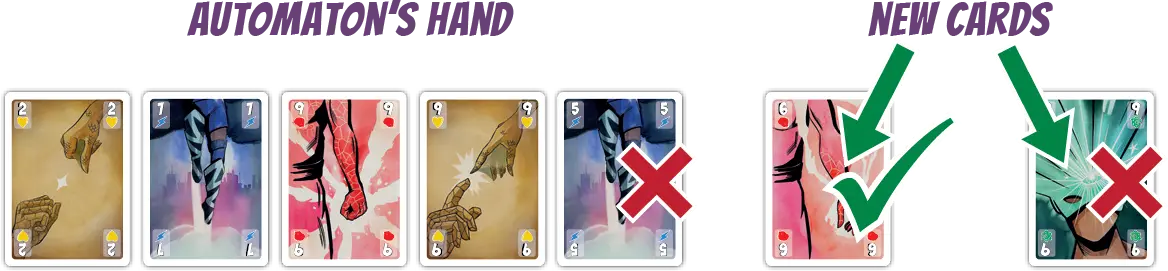
Automaton has no in her hand, so you discard the drawn 9. She does have a card, so she keeps the 6. With 1 card kept, you must discard 1 card from the right of her hand: 5 then place the 6 at the right side of her hand.
Automaton now has 2 lead suit cards but none that can beat your card, so she plays the lowest of them: 6.
Example 2: You play hero and Automaton leads in the fourth trick:
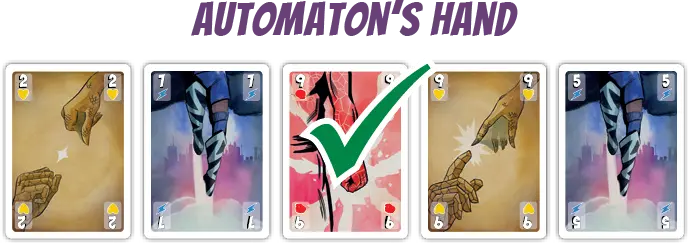
Since she leads the trick, she plays the highest card she has. 9 and 9 tie for highest, so she chooses the leftmost of them: 9.
Factoryon has the cards shown below. You draw 2 cards:
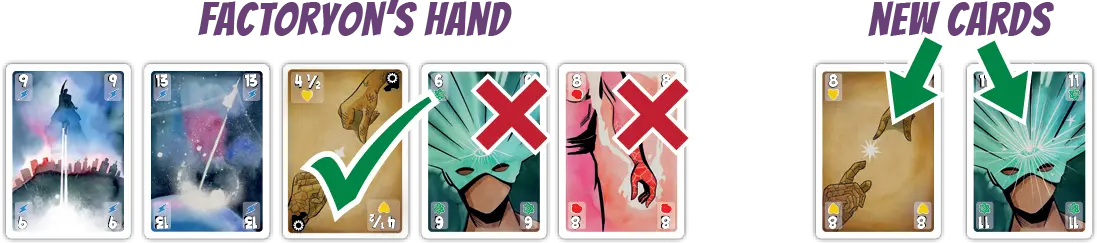
She has both and cards in her hand, so both drawn cards are kept and you discard the 2 rightmost cards, 6 and 8. 8 was drawn first, so you place it first and 11 becomes the rightmost card.
Since you aren’t playing villain and Factoryon has no cards in the lead suit (), she plays her lowest card, which is the 4½ extra-love card that beats Automaton’s 9.
Example 3: You play hero, have led with 9 in the fourth trick, and Automaton has played 7. Factoryon follows, so you draw 2 cards:
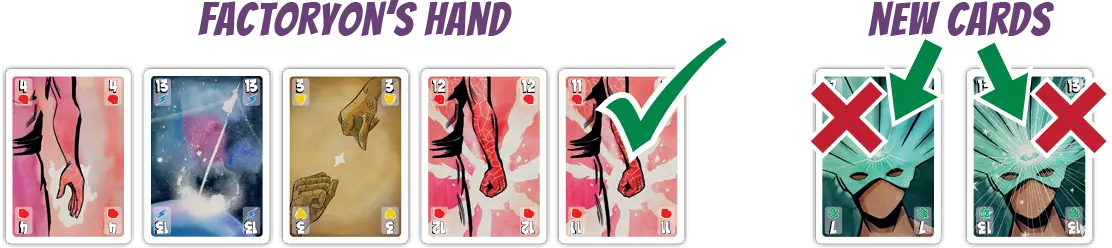
Both new cards are of which she has none, so you discard both.
Since you aren’t playing villain and Factoryon has cards of the lead suit (11 and 12) that beat all cards played in the trick (9 and 7), she plays the lowest of them: 11.
Had Automaton played 2 instead of 7, Factoryon would have had no lead suit card that beats all the played cards and thus she would have played her lowest lead suit card, 4.
Examples: Winning a trick
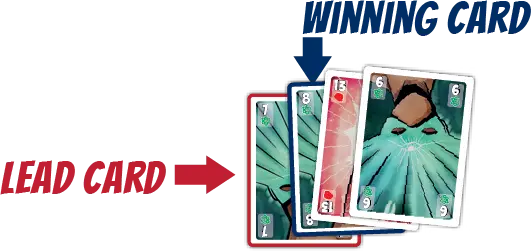
The highest-valued card does not win because it doesn’t follow suit (and isn’t a trump).
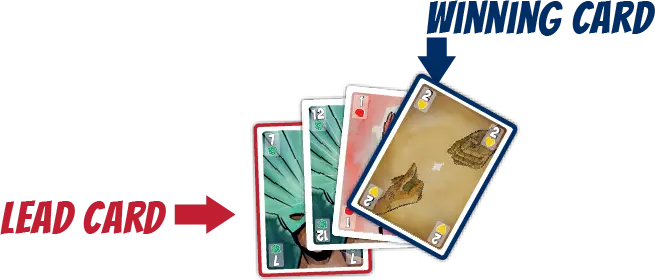
A low-value card wins because it’s a trump.